Prosecution, Transparency, and the Measure of Justice in 2025
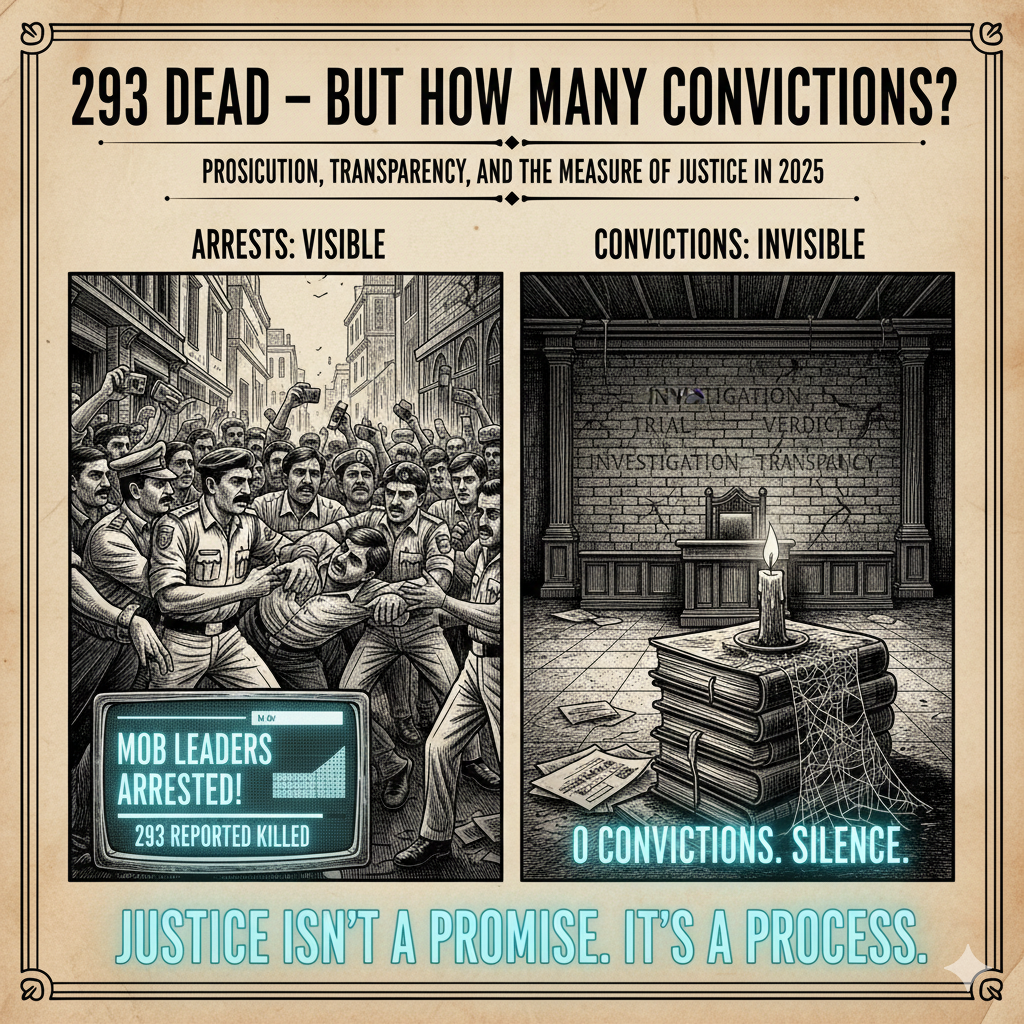
Part 9 of 10 — 293 Lives, One Year
Published: 28 December 2025
If a life is taken and no conviction follows, what message does that send?
In 2025, approximately 293 people were reported killed in mob-related violence across Bangladesh during the broader period of unrest. The number is documented.
But numbers alone do not tell us whether justice followed.
This part of the series asks a simple, uncomfortable question:
How many cases moved beyond arrest?
Arrest Is Not Justice
After many mob incidents in 2025, authorities announced arrests.
That matters.
But arrest is not the final step. It is the first.
Justice requires:
- Charges filed
- Cases transferred to court
- Evidence presented
- Trials conducted
- Judgments delivered
- Outcomes made public
Without that chain, deterrence remains weak.
The public rarely saw that full chain this year.
The Visibility Gap
In reviewing publicly reported cases from 2025, a pattern emerges:
- Arrest announcements were visible.
- Investigation updates were limited.
- Court proceedings were rarely covered.
- Conviction data was difficult to find.
This creates what can be called a visibility gap.
When citizens cannot see outcomes, confidence declines.
And when outcomes are invisible, perpetrators assume consequences are unlikely.
Transparency is not symbolic.
It is preventive.
Why Convictions Matter
Convictions serve three purposes:
- Justice for victims.
- Deterrence for future offenders.
- Restoration of public trust.
If convictions are rare or delayed, each of those purposes weakens.
Mob violence is not spontaneous forever. It becomes habitual when consequences are uncertain.
In 2025, repeated incidents suggest deterrence was not strong enough.
The Structural Question
This is not about blaming individual officers or prosecutors.
It is about capacity.
Were investigative resources sufficient?
Were witness protection systems strong?
Were cases prioritised properly?
Was political pressure influencing outcomes?
These are structural questions — and structural questions belong in elections.
What Voters Should Ask Before Casting a Ballot
As Bangladesh approaches a national election, voters should not only evaluate campaign speeches.
They should ask for measurable commitments:
- Will prosecution data be publicly accessible?
- Will mob violence cases be fast-tracked?
- Will independent monitoring bodies oversee investigations?
- Will victim families receive legal support?
- Will annual conviction reports be published?
Because justice is not a promise.
It is a process.
And processes require leadership.
The Real Meaning of 293
The number 293 should not only represent loss.
It should represent evaluation.
If cases are unresolved, if conviction rates are unclear, if transparency is limited — then reform is necessary.
Democracy allows citizens to demand reform.
But reform begins with memory.
The Final Chapter Approaches
Part 10 will conclude this series by asking a final question:
What must change in 2026 so that 2025 is not repeated?
Because elections are not only about choosing leaders.
They are about choosing standards.
Note:
This image is AI-generated and used to reflect the atmosphere and message of the article. It is not a photograph from the actual incident, but a visual aid to help frame the context.