Published: 29 March, 2026
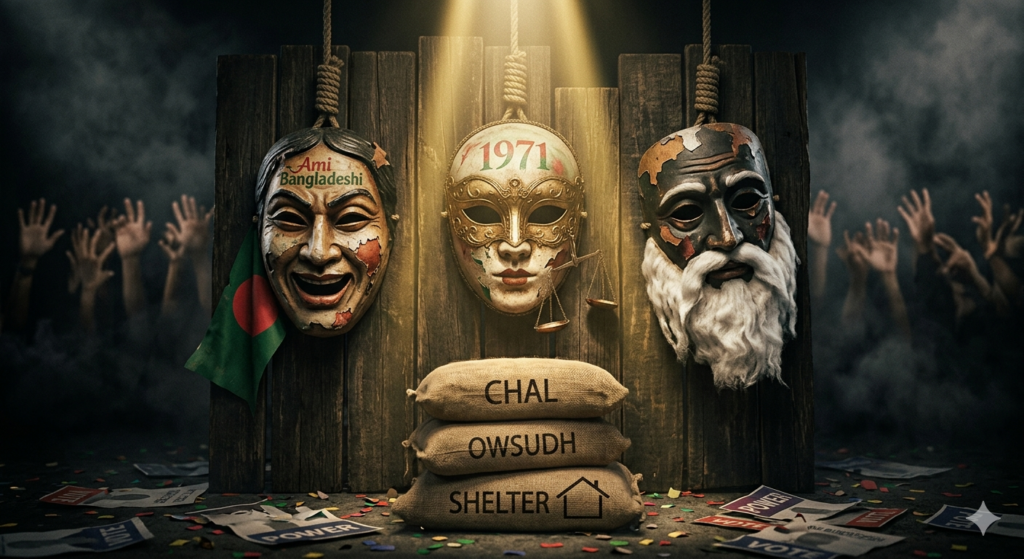
We have a long-standing tradition in Bangladesh, but it isn’t one we should be proud of. It is the tradition of the “Political Mask.” For decades, our political stage has been a theater of costumes. One party wears the cloak of the pious scholar, another the robes of the secular liberator, and another the uniform of the patriot.
But as the curtains fall in 2026, the audience—the people—is beginning to realize that under these masks, the faces are identical. They are the faces of power-seekers who use “cheap dramas” to underestimate our intelligence.
1. The Many Faces of the Mask
Every major party in Bangladesh has a “saintly” script designed to bypass our logic and trigger our emotions.
- The Religious Mask (e.g., Jamaat-e-Islami): They use the “purity” of Sharia to claim moral superiority. Yet, history shows they are happy to rewrite their “eternal” constitutions or join secular coalitions the moment a seat in the cabinet is offered. Their “Islam” is often a political brand, not a spiritual practice.
- The Secular Mask (e.g., Awami League): They present themselves as the “Guardians of 1971” and the protectors of secularism. However, they have historically balanced this by bowing to extremist demands or keeping “State Religion” in the constitution to keep the religious vote. Their “secularism” is often a shield used to silence critics, not a true commitment to pluralism.
- The Nationalist Mask (e.g., BNP): They drape themselves in the flag and “Bangladeshi Nationalism.” They promise “Faith in Allah” in the constitution to win over conservatives, but their history is filled with tactical alliances and power-sharing that prioritize elite survival over the sovereignty of the common man.
2. The Intellectual Underestimation
The most insulting part of this performance is what it says about us. By using religious slogans or liberation war grievances to win votes, these parties are essentially saying: “The Bangladeshi people are not smart enough to demand a healthcare plan; they just need a slogan.”
They keep us busy arguing about who is more Bengali or who is a better Muslim so that we don’t look at the empty pantry or the crumbling school. They turn our neighbors into enemies over “ideology” while they share tea in the corridors of power.
3. The Only Metric That Matters: The Five Basic Rights
It is time to stop being the audience for their “cheap dramas.” We must demand that the “Saints” become “Servants.”
Logic dictates that if a party truly loved the people—whether through the lens of Islam, Secularism, or Nationalism—they would prioritize the Five Basic Rights before anything else. In 2026, the demand must be clear: Rights first, Legislation later.
- Food: A party’s “faith” is meaningless if the people cannot afford a meal.
- Clothing: Dignity is not a political slogan; it is a basic human necessity.
- Shelter: If you cannot guarantee a roof for the poor, your “nationalism” is a lie.
- Education: We don’t need “ideological” training; we need skills that allow us to compete globally.
- Healthcare: A “secular” hospital and a “religious” hospital should both have medicine. If they don’t, the mask has failed.
Conclusion: Refuse to Applaud
The “Saint Mask” is a tradition of distraction. It allows leaders to rule by emotion rather than by accountability.
It is time to tell every party—from the most “pious” to the most “liberal”—that we are no longer intellectually underestimated. We do not want your dramas. We do not want your scripted outrage. We want our five rights.
If they cannot provide the basics, they have no right to preach. Let us tear down the masks and demand a government that serves the living, not the script.
Reflection for the Reader
In the 2026 landscape, every party is asking for your loyalty. Ask them: “Can I eat your ideology? Does your ‘secularism’ fix my local clinic? Does your ‘Sharia’ lower the price of rice?” If the answer is no, it’s just another mask.
Note:
This image is AI-generated and used to reflect the atmosphere and message of the article. It is not a photograph from the actual incident, but a visual aid to help frame the context.
don’t you think we can reach you?
Thanks for your valueable comment. If you see these data and the article itself as a fact based information rather than seeing all personally, then you might get a broader vision of what i tried to say. I did not say anything against my country everything i said was against a political party, couple of actually and BNP-Jamaat were two of them. And all of them are in favor of my country’s interest, this is sad that you don’t feel it in that way .
The world is small place to hide .