From Uprising to Unfinished Revolution
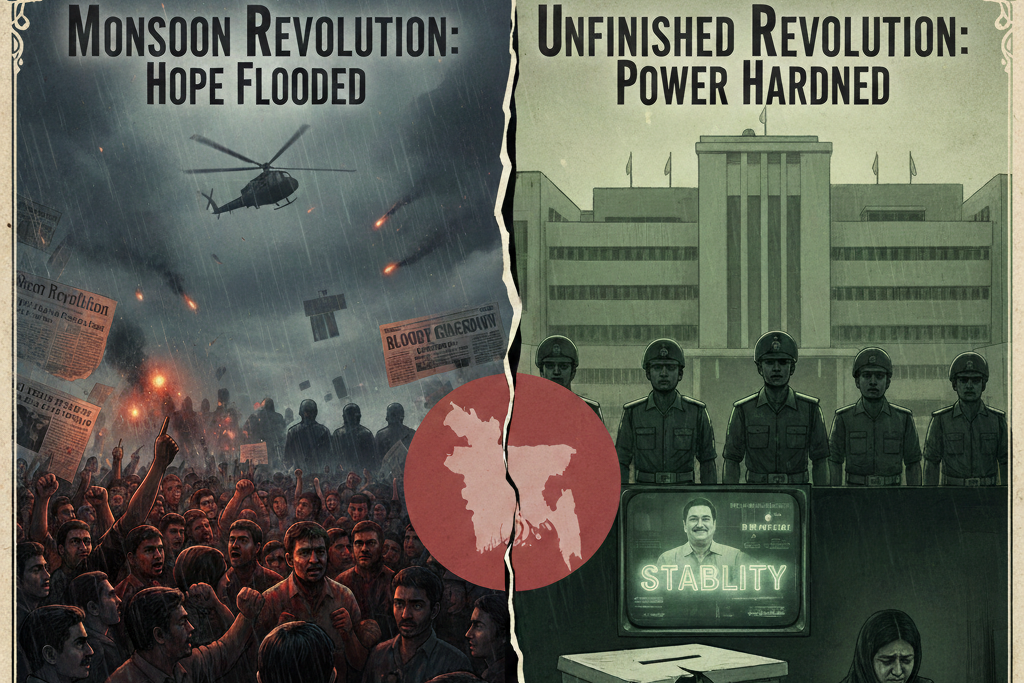
Published: 18 February, 2026.
Bangladesh did not experience one revolution between 2024 and 2026 – it lived through two. The first was the Monsoon Revolution: a mass uprising that toppled Sheikh Hasina and raised hopes of democratic renewal. The second, quieter one came from above, as an interim government and its allies rebuilt power in their own image, prompting many to ask whether Bangladesh has simply traded one authoritarianism for another.
The Monsoon Revolution: When Hope Flooded the Streets
The Monsoon Revolution began with student protests demanding fairer government job quotas, but it quickly grew into a nationwide revolt against corruption, dynastic politics and rigged elections. Peaceful demonstrators were met with bullets, curfews and internet shutdowns; hundreds were killed and thousands injured as security forces opened fire, even from helicopters, on unarmed crowds.
Instead of breaking the protests, the violence broadened them. Garment workers, rickshaw pullers, office employees and parents joined the students, turning city squares into seas of people demanding dignity and genuine democracy. On 5 August 2024, under mounting public pressure and after the army signalled it would no longer underwrite a bloody crackdown, Sheikh Hasina fled the country, ending almost sixteen years in power.
In homes across Bangladesh, families of those killed believed their loved ones had died opening a door to a new kind of politics – one where no leader stood above the law, and no election result was scripted in advance.
An Interim Government That Forgot It Was Interim
Into this emotional vacuum stepped an interim government, branded as technocratic and neutral, and led by figures with international prestige. Its mandate sounded clear: stabilise the country, reform broken institutions, and organise free and inclusive elections.
In reality, the transition looks very different up close. Key state institutions – especially the judiciary, election commission and bureaucracy – were reengineered from the top down with minimal transparency or public participation. Security forces implicated in the bloodiest days of the Monsoon Revolution were left largely unreformed; the same uniforms still patrol the same streets, and for many citizens they symbolise impunity rather than protection.
A familiar narrative resurfaced: “stability first, democracy later.” That line had long been used by the old regime to justify abuses. Hearing it again from new power‑holders was the first warning sign that the revolution’s logic was being quietly reversed.
Banning the Largest Party: Democracy with a Hole in the Middle
Nothing captures this reversal more clearly than the treatment of the Awami League (AL) before the 12 February 2026 general election. The Election Commission suspended the AL’s registration, while courts reshaped under the interim authorities convicted Sheikh Hasina and sidelined the party’s leadership.
On paper, voters could still cast ballots. In practice, millions of citizens who had always identified with the AL discovered that their party – and their political identity – had been administratively erased. They had a vote, but not their voice.
Analysts from across the spectrum, including long‑time critics of Hasina, described this as mass disenfranchisement and warned that any election excluding the country’s largest party is democracy with a hole in the middle. If democracy means real competition, then legally removing your main rival looks less like renewal and more like a sophisticated, legalistic form of the one‑party dominance the revolution was supposed to end.
Violence, Fear and “Democracy in Darkness”
Authoritarian systems are not only defined by constitutions and laws; they are felt in the body as fear.
Political violence did not vanish after August 2024 – it changed shape. Clashes, targeted killings and episodes of mob justice continued to scar the transition, while security forces remained willing to use deadly force in the name of order. Human rights groups documented ongoing abuses, but meaningful accountability remained partial and selective.
Journalists and independent media faced attacks, intimidation and legal pressure, especially around the 2026 vote. Press freedom organisations described a climate of “democracy in darkness”, where censorship and self‑censorship left citizens guessing more than knowing.
To humanise this, imagine a mother in Sylhet who lost her son in July 2024 when security forces fired into a crowd. She celebrated when Hasina fell, believing her child’s death had forced a new social contract. Two years later, she watches a different set of powerful men decide who can run for office, sees the same uniforms on patrol, and hears that “for national security”, some parties and voices must once again be silenced. From her perspective, has power really changed – or just changed hands?
The Logic of a Recycled Authoritarianism
Strip away labels like “revolutionary” and “interim”, and a similar architecture appears on both sides of the transition.
- Monopoly over the state
Under the old regime, courts, police and election bodies were bent to protect one party and its leader. Under the new order, reconfigured institutions have been used to legally crush the main rival camp and insulate the current power structure from real challenge. - Security above rights
Previously, killings, enforced disappearances and rigged polls were justified as the price of stability and development. Today, bans on parties, restrictions on protests and tough policing are defended as necessary to avoid chaos and “never again” instability. - Elections without genuine choice
Under Hasina, Bangladesh held elections widely described as managed or sham, with opposition figures harassed, jailed or absent. Under the new dispensation, the 2026 election went ahead with the largest party outlawed, participation overshadowed by fear and media under assault.
If both systems monopolise the state, subordinate rights to “stability”, and stage elections designed to minimise the risk of losing, then both are authoritarian in substance, even if one wraps itself in the language of revolution and technocracy.
The Unfinished Promise of the Monsoon Revolution
The meaning of the Monsoon Revolution is still being fought over. For parts of Dhaka’s elite, it was a necessary correction: it removed an entrenched leader and opened space for better economic and administrative management. For the young protesters who faced bullets, it was meant to be something more radical – a demand that no one, ever again, stand above the constitution and above the people.
If Bangladesh has indeed exchanged one authoritarian system for another, it is not because the revolution failed to happen. It is because the revolution has been frozen halfway. The streets did their part. The institutions did not.
Finishing that revolution would mean rebuilding genuinely independent courts, police, and election bodies; allowing all major political forces back into open, peaceful competition; and treating the blood spilled in 2024 not as a fading memory, but as a binding moral contract. Whether Bangladesh becomes a warning or an inspiration will depend on whether it can finally align the courage shown in the streets with the courage needed inside its institutions.
Note:
This image is AI-generated and used to reflect the atmosphere and message of the article. It is not a photograph from the actual incident, but a visual aid to help frame the context.