The Standard Bangladesh Must Choose in 2026
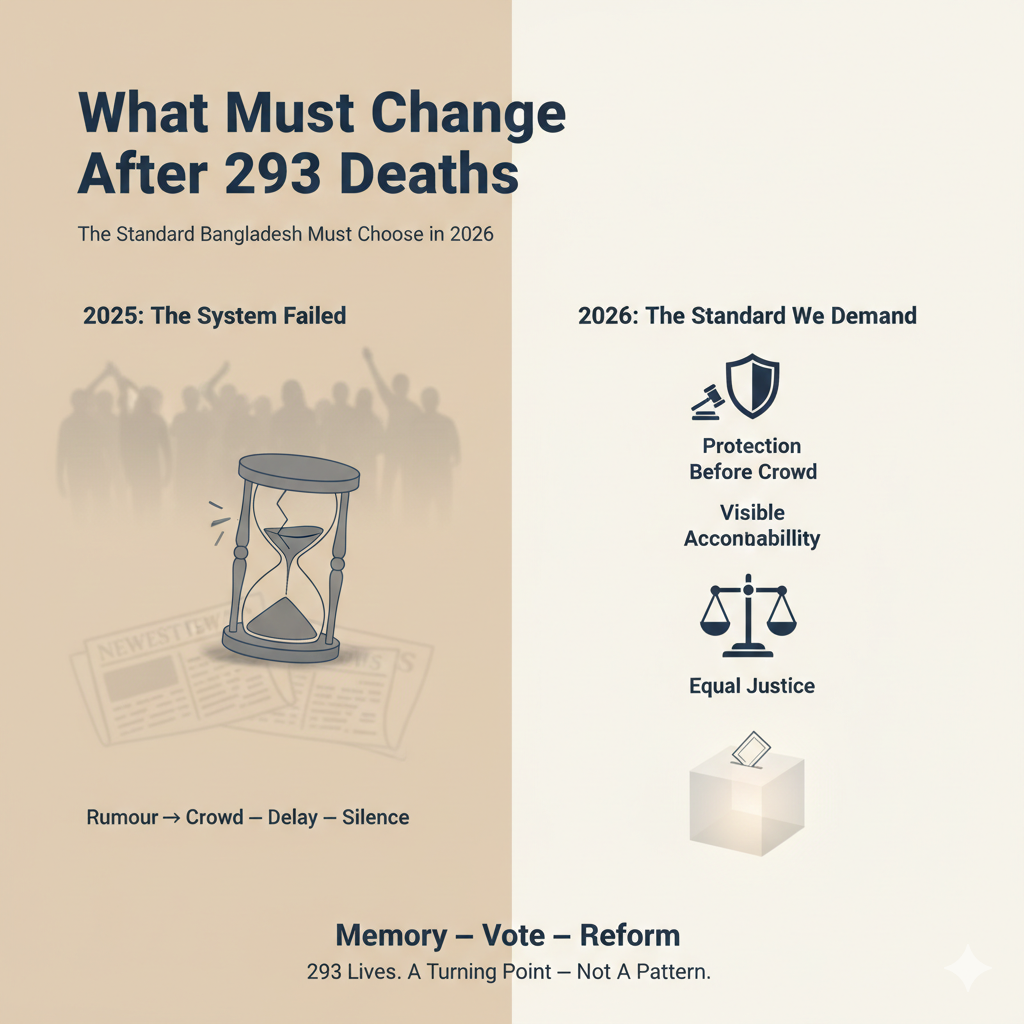
Part 10 of 10 — 293 Lives, One Year
Published: 29 December 2025
This series began with a promise.
A promise that the streets would calm.
That order would return.
That law would protect before crowds gathered.
But 2025 recorded 293 deaths linked to mob violence.
And numbers demand reflection.
Now that we have examined the patterns — faith misused, rumours amplified, law delayed, cases fading, confidence growing, minorities vulnerable, convictions unclear — one final question remains:
What must change?
2025 Was Not Only a Year of Violence
It was a year of exposure.
It exposed:
- How quickly accusations spread.
- How slowly intervention sometimes followed.
- How inconsistent transparency weakened trust.
- How vulnerable communities felt unprotected.
- How unresolved cases quietly disappeared.
These are not emotional conclusions.
They are structural observations.
And structures can be redesigned.
The First Standard: Law Before Crowd
No matter the allegation, no matter the emotion, no matter the identity —
Protection must arrive before punishment.
That means:
- Immediate secure custody for the accused.
- Rapid-response units trained in mob dispersal.
- Real-time monitoring of viral misinformation.
- Clear communication from authorities within minutes, not hours.
If this does not become non-negotiable, repetition is inevitable.
The Second Standard: Visible Accountability
Arrests are not enough.
Citizens must be able to see:
- Charges filed.
- Court proceedings initiated.
- Convictions delivered.
- Sentences enforced.
Transparency deters violence more effectively than speeches.
Without visible outcomes, rumours regain confidence.
The Third Standard: Equal Protection
A functioning democracy protects its most vulnerable first.
If minorities hesitate to report threats, if families fear retaliation for pursuing justice, if some identities feel less secure than others —
Then equality under law is incomplete.
And incomplete equality is instability.
The Fourth Standard: Political Courage
Leaders must do something difficult:
Publicly reject mob violence even when perpetrators are politically convenient.
Silence is interpreted as tolerance.
Selective outrage is interpreted as strategy.
The next chapter of Bangladesh must demand leaders who isolate violence — not manage it.
What Voters Must Decide
Elections are not about rewarding speeches.
They are about choosing systems.
Before casting a ballot, citizens should ask:
- Who has a measurable plan to reduce mob violence?
- Who commits to publishing prosecution data annually?
- Who strengthens institutional independence?
- Who ensures rapid intervention in vulnerable districts?
If 293 deaths in one year do not shape voting decisions, then memory has failed.
2025 Should Not Become Normal
The most dangerous outcome is not outrage.
It is normalisation.
If citizens begin to accept that rumours will kill, that crowds will form, that cases will fade, that accountability will stall —
Then reform becomes impossible.
But if citizens remember clearly and vote carefully —
Then 2025 becomes a turning point, not a pattern.
The Responsibility of Memory
This series did not name parties.
It did not endorse candidates.
It documented a year.
Because democracy requires informed citizens.
And informed citizens require memory.
293 lives were lost.
The question now is not who to blame.
The question is whether Bangladesh will demand a higher standard.
The future is chosen quietly — in voting booths.
But it is shaped by what we refuse to forget.
Note:
This image is AI-generated and used to reflect the atmosphere and message of the article. It is not a photograph from the actual incident, but a visual aid to help frame the context.