Informal Authority, Political Protection, and Mob Confidence in 2025
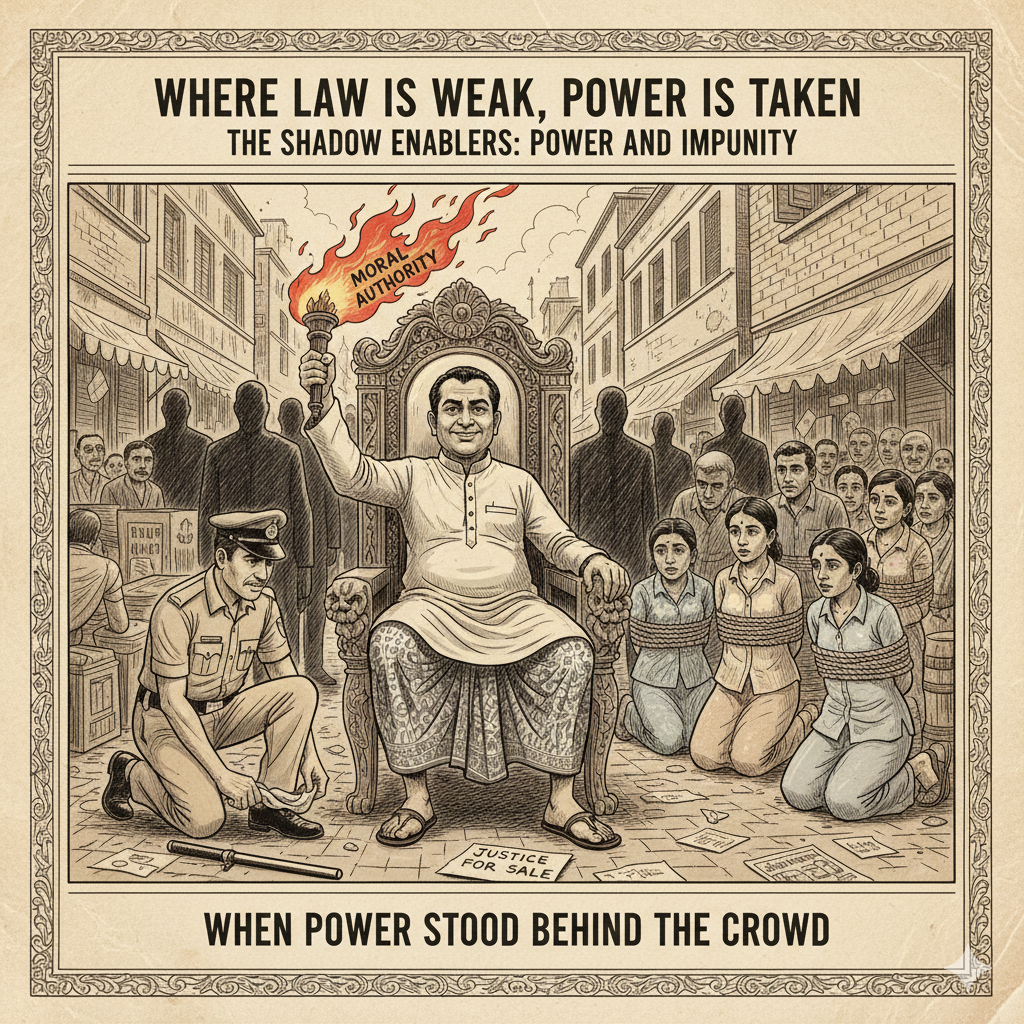
Part 6 of 10 — 293 Lives, One Year
Published: 25 December 2025
In the previous chapter, we asked where the law was.
Now we must ask something harder:
Why were some crowds so confident?
Mob violence is not sustained by anger alone.
It is sustained by belief.
Belief that:
- Intervention will be slow.
- Arrests will be limited.
- Prosecution will fade.
- Someone powerful will quietly protect you.
When that belief spreads, mobs become bolder.
And 2025 showed signs of that boldness.
Violence in Broad Daylight
Throughout 2025, multiple mob attacks occurred openly:
- In factory zones
- In busy marketplaces
- On public roads
- In front of cameras
When violence happens in daylight, in public, without disguise, it signals something dangerous:
Perpetrators are not afraid.
Fear of law is deterrence.
Absence of fear is permission.
The Role of Local Influence
In several reported incidents this year, human rights observers noted that:
- Local community leaders were slow to intervene.
- Political figures condemned violence publicly but did not follow up visibly.
- Arrests, where made, often targeted low-level participants rather than organisers.
- Public updates on prosecution were limited.
This does not automatically prove direct political involvement.
But it does raise a structural concern:
When informal authority figures do not act decisively against mob behaviour, silence can be interpreted as tolerance.
And tolerance fuels repetition.
The Confidence Problem
Mob violence does not spread randomly.
It spreads when consequences are uncertain.
If a group believes:
- Their political alignment shields them,
- Local leaders will soften the outcome,
- Police will avoid confrontation,
- Cases will dissolve quietly,
then violence becomes easier.
In 2025, too many incidents suggested that perpetrators felt protected — not necessarily by law, but by environment.
That environment is shaped by leadership culture.
The Cost of Selective Enforcement
Selective enforcement is more damaging than weak enforcement.
If citizens believe that:
- Some groups are prosecuted,
- Others are ignored,
- Some identities receive protection,
- Others are vulnerable,
then trust erodes completely.
Rule of law must be uniform.
Otherwise, it becomes performance.
When 293 people die in mob-related violence in one year, citizens must ask not only:
Why did crowds act?
But also:
Why did they feel safe acting?
Political Power and Moral Responsibility
This article does not accuse any specific individual or party of directing violence.
It asks a structural question:
Did leadership culture in 2025 send strong enough signals that mob action would not be tolerated — regardless of who committed it?
Strong leadership does three things:
- It intervenes early.
- It prosecutes transparently.
- It publicly isolates perpetrators from political protection.
If any of those three are weak, mob confidence grows.
What Voters Must Consider
As the national election approaches, voters must think beyond speeches and alliances.
They must evaluate:
- Which leaders clearly reject mob behaviour from their own supporters?
- Who publishes prosecution outcomes transparently?
- Who reforms local governance to prevent informal strongmen from operating above law?
- Who strengthens internal police accountability?
Because systems reflect priorities.
And priorities reflect leadership.
The Lesson of 2025
2025 did not only reveal anger.
It revealed boldness.
Boldness emerges when deterrence fades.
If informal power networks quietly protect violent behaviour, mobs will continue to test boundaries.
The 293 deaths of 2025 were not only caused by rumours or delay.
They were enabled by confidence.
And confidence grows where accountability shrinks.
The Series Continues
Part 7 will examine disappearances and unresolved cases — the deaths and assaults that slipped quietly out of headlines without resolution.
Because sometimes injustice is loud.
And sometimes it disappears silently.
Both matter.
Note:
This image is AI-generated and used to reflect the atmosphere and message of the article. It is not a photograph from the actual incident, but a visual aid to help frame the context.