Institutional Failures Behind 293 Deaths
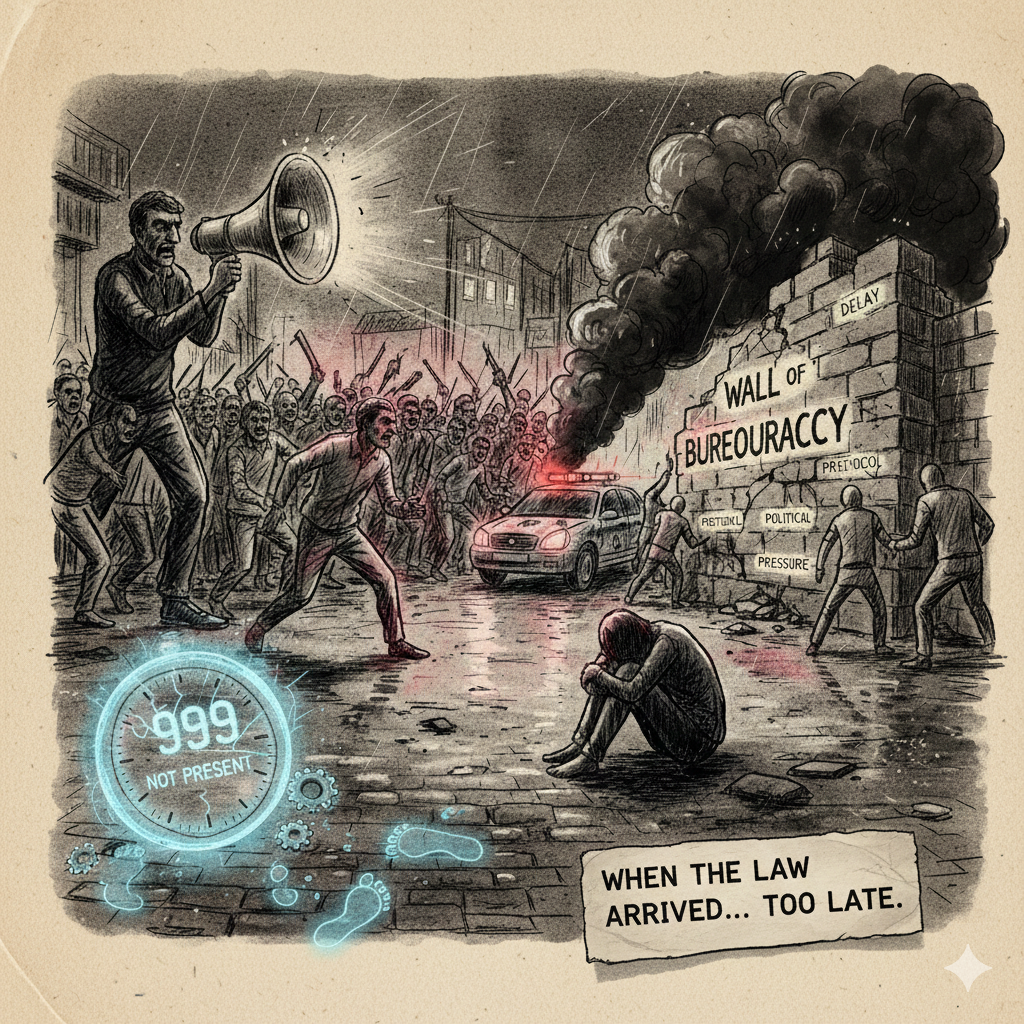
Part 5 of 10 — 293 Lives, One Year
Published: 24 December 2025
In the previous parts of this series, we examined how violence unfolded in 2025 — broken promises, religious accusations, rumours, and the human faces behind the numbers.
Now we ask a harder question:
Where was the law?
Not in theory.
Not in speeches.
But in the minutes between accusation and assault.
Because those minutes determine whether a society is governed by courts — or by crowds.
The Pattern of Delay
Across documented mob incidents in 2025, one pattern repeated:
- Accusation spreads
- Crowd gathers
- Violence escalates
- Police arrive after injury
Sometimes officers were outnumbered.
Sometimes they were informed too late.
Sometimes they hesitated.
But the result was the same.
Intervention was reactive, not preventive.
And reactive law does not deter mobs. It only documents aftermath.
The Protection Gap
A functioning rule-of-law system protects the accused immediately — regardless of whether they are guilty.
In several 2025 cases:
- Individuals were not secured quickly after accusations.
- Protective custody was delayed.
- Crowd dispersal measures were insufficient or late.
- Intelligence monitoring of viral rumours was weak.
This created what can only be described as a protection gap.
When protection gaps repeat across districts, they stop being accidents.
They become institutional weaknesses.
Why Deterrence Failed
Deterrence depends on certainty.
If people believe that:
- Police will intervene immediately,
- Arrests will follow violence,
- Prosecution will be transparent,
- Convictions will be public,
then mob behaviour decreases.
But if enforcement is slow, unclear, or selective, a different message spreads:
Nothing will happen.
In 2025, too many perpetrators acted in daylight.
That suggests something deeper than anger.
It suggests confidence.
Confidence that consequences would be minimal.
The Silence After the Incident
After many mob killings, the pattern continued:
Press statement.
Promise of investigation.
Gradual disappearance from headlines.
Public updates on prosecution were rare.
Court outcomes were rarely visible.
Families often waited without clarity.
When justice is invisible, deterrence weakens further.
Transparency is not optional. It is preventative.
Leadership and Systems
It is easy to blame crowds.
But crowds do not design policing systems.
Crowds do not allocate budgets.
Crowds do not establish rapid-response protocols.
Leadership does.
If 293 people died in mob violence during 2025, the question is not only moral — it is administrative.
Were emergency response units adequate?
Was misinformation monitoring effective?
Were local officers empowered to act quickly?
Were political pressures influencing enforcement decisions?
These are not abstract concerns.
They are electoral questions.
What Voters Must Evaluate
As the national election approaches, citizens must move beyond emotional appeals and ask structural questions:
- Which leadership team has a concrete plan for rapid intervention in mob situations?
- Who will create public reporting dashboards for mob violence cases?
- Who will reform accountability mechanisms inside law enforcement?
- Who will guarantee protection for the accused before investigations conclude?
Order is not restored by announcing it.
It is restored by building systems that act faster than crowds.
The Hard Lesson of 2025
The tragedy of 2025 was not only that mobs formed.
It was that in too many cases, they had enough time to act.
That is a systems failure.
If law enforcement arrives consistently within minutes, violence decreases.
If it arrives after death, trust decreases.
This series does not aim to inflame.
It aims to record.
Because elections are moments of redesign.
And redesign requires memory.
What Comes Next
Part 6 will examine whether unlawful power structures — local strongmen, political protection networks, and informal authority — played a role in enabling mob confidence in 2025.
Because institutional weakness is rarely isolated.
It is often connected to power.
Note:
This image is AI-generated and used to reflect the atmosphere and message of the article. It is not a photograph from the actual incident, but a visual aid to help frame the context.