The Timeline of Hadi’s Killing — And the Silence That Followed
Published: 15 February 2026
Democracy did not begin on election day.
It began with a killing. Before the 2026 general election. Before the turnout percentages. Before the praise. Hadi was killed. And for a moment, the nation paid attention.Then it didn’t.
The Timeline
Phase 1 — The Killing
Hadi’s death was not quiet.
It was public. It was political.It was disturbing. Initial reactions were immediate: Statements of condemnation. Promises of investigation. Calls for justice. The atmosphere was tense.
Questions were urgent.
Who did this?Why now? Was it politically motivated? Who benefits from silence?
At that moment, justice felt like a national priority.
Phase 2 — The Investigation Promised
Officials assured the public that the case would be investigated. The language was familiar:
“Proper action will be taken.”
“The perpetrators will not escape.”
“We are committed to justice.”
But visible updates were limited.
Were arrests made?
Were suspects identified?
Was the public informed about investigative progress?
Information slowed.
Then it stalled.
Phase 3 — The Election Takes Over
As the general election approached, the national focus shifted. Campaign rallies grew larger. Political messaging intensified. Television debates moved from justice to strategy. Headlines changed. Election preparedness. Turnout predictions. Security arrangements. And gradually, Hadi’s name appeared less often.
Not because the case was resolved. But because something louder replaced it.
Phase 4 — Election Day Success
Voting day came.
Reports described it as largely peaceful. Turnout was discussed. International observers commented on stability.The narrative became:
“Bangladesh has conducted a successful election.”
That may be true in procedural terms. But success in procedure does not erase unresolved questions.
Phase 5 — Counting Questions
After voting, debates emerged about counting transparency.
Some sources raised concerns about tabulation in certain constituencies.
Recount demands surfaced. The country debated margins.
But almost no one asked:
What is the status of Hadi’s case?
It was as if democracy had been reduced to ballots alone.
The Human Cost Behind the Silence
Hadi was not a headline.
He was a son.
A friend.
A citizen.
His family did not experience “election success.”They experienced loss.While analysts discussed turnout percentages, a family waited for answers.
Democracy is tested in moments like this.
Not when votes are cast —
but when justice is pursued.
A Question for the Government
If the election was conducted successfully, that is commendable. But governance is not only about administering ballots. It is about administering justice. If investigations are ongoing, publish updates. If suspects are identified, inform the public. If there are obstacles, explain them. Silence creates suspicion. Transparency builds legitimacy.
A Question for the Media
Media attention shapes national urgency. In the days following Hadi’s killing, coverage was intense. After the election, coverage diminished. Election graphics replaced investigative follow-ups. Debates about counting replaced questions about accountability. The press is not obligated to remain emotional.
But it is obligated to remain persistent. Justice requires repetition.
A Question for Citizens
Before the election, many citizens demanded:
“Democracy must be practiced.”
What does practicing democracy mean?
Does it mean:
Holding a peaceful vote?
Or does it mean:
Demanding visible justice when political attention shifts?
If we celebrate election day but forget unresolved killings, we risk building a democracy that performs well publicly — and fails quietly privately.
The Hard Standard
The real test is not whether voting was fair. The real test is whether institutions pursue justice with equal urgency. If Hadi’s case moves forward transparently, democracy strengthens. If it fades into memory while political success narratives dominate, something is wrong. Because democracy is not validated by applause.
It is validated by accountability.
The Slap We Don’t Want to Admit
We often say we want real democracy. But real democracy demands uncomfortable persistence.
It demands that we:
Keep asking. Keep following. Keep documenting. Even when the celebration begins. Hadi’s death happened before the ballots. If justice does not follow after them,
then something fundamental remains incomplete.
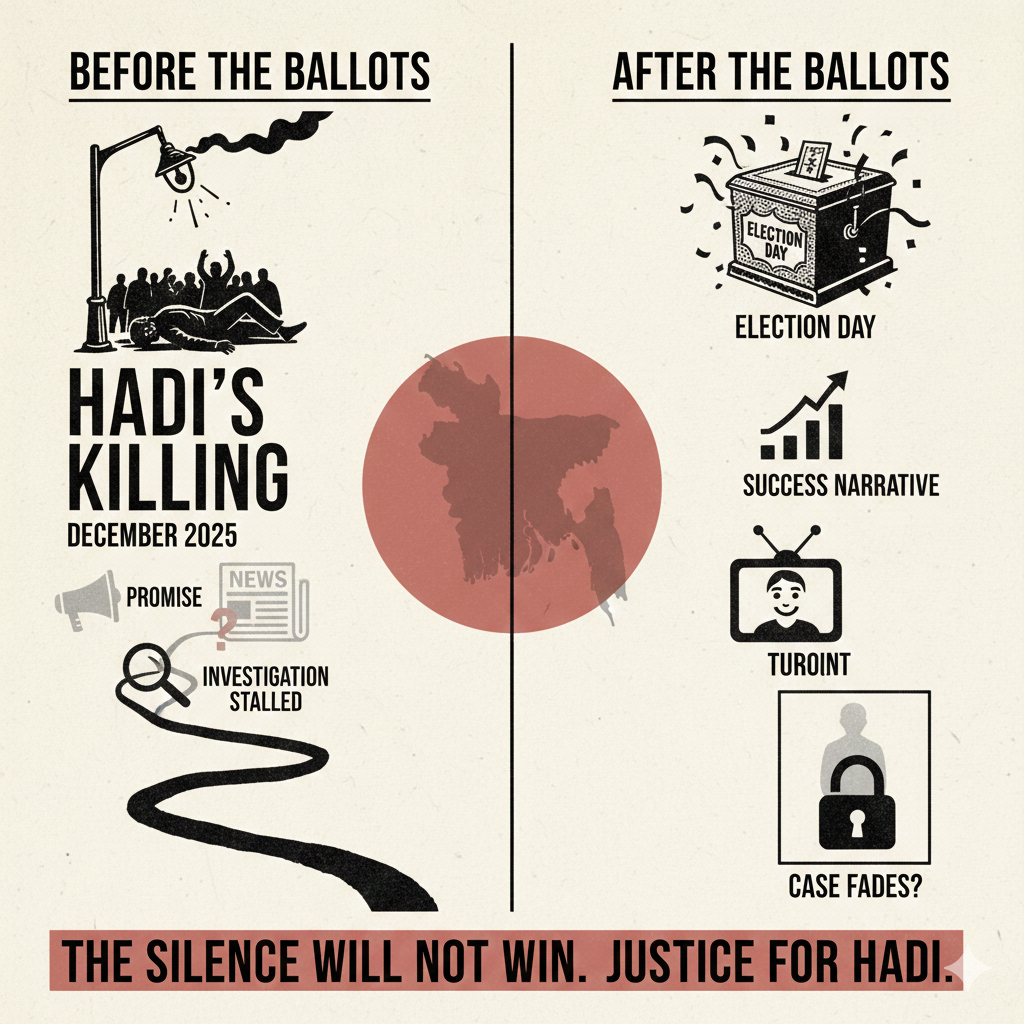
Note:
This image is AI-generated and used to reflect the atmosphere and message of the article. It is not a photograph from the actual incident, but a visual aid to help frame the context.